Posts

New guideline for the treatment of sinusitis released by the Infectious Diseases Society of America (IDSA).

Image
The new guideline emphasize that the vast majority of sinus infections are caused by viruses and should not be treated with antibiotics. In those cases the new guidelines call for shorter treatment time than older guidance, which suggested a 10 to 14 days weeks of antibiotic treatment for a bacterial infection. The IDSA  guideline  suggests that five to seven days is long enough to treat  most bacterial infection without encouraging resistance in adults, though children should still receive the longer course. Because of increasing resistance to amoxicillin (the current standard of care) the guideline recommends amoxicillin-clavulanate as the treatment of choice for acute sinusitis.   A moxicillin-clavulanate   is a combination that helps to overcome antimicrobial resistance by inhibiting an enzyme that breaks down the antibiotic. The guidelines also recommend against other commonly used antibiotics, including azithromycin, clarithromycin and trimethoprim/...

Is amoxacillin an adequate agent for the treatment of sinusitis?

Image
A recent   study by   Garbutt   and associates evaluated   the   effect of amoxicillin treatment over symptomatic treatments for adults with clinically diagnosed acute sinusitis. They performed   a randomized, placebo-controlled trial of 166 adults with uncomplicated, acute sinusitis between 2006 and 2009. Patients were randomized to receive a 10 days course of either amoxicillin ( 85 patients) or placebo (81 patients). All received a supply of symptomatic treatments for pain, fever, cough, and nasal congestion to use as needed.   On day 3 of treatment, there was no difference in improvement between placebo-takers and those prescribed antibiotics. On day 7, the antibiotic group reported a slight improvement that the researchers said was unlikely to represent a noticeable relief in symptoms, but that edge disappeared by day 10, when 80 percent of patients in both groups reported they felt better or cured. The main problem in this study is that many of t...

Are systemic corticosteroids effective in relieving symptoms of acute sinusitis?

Image
Systemic corticosteroids are frequently used to treat acute sinusitis. A recent analysis of the Cochrane Central Register of Controlled Trials (CENTRAL) assess the effectiveness of systemic corticosteroids in relieving symptoms of acute   sinusitis . Four randomized controlled trials with a total of 1008 adult participants met the inclusion criteria. All participants received oral antibiotics and were assigned to either oral corticosteroids (prednisone 24 mg to 80 mg daily or betamethasone 1 mg daily) or the control   treatment   (placebo in three trials and non-steroidal anti-inflammatory drugs in one trial). In all trials, participants treated with oral corticosteroids were more likely to have short-term resolution or improvement of symptoms than those receiving the control   treatment : at Days 3 to 7. An analysis of the three trials with placebo as a control   treatment   showed similar results but with a lesser effect size: No data on the long-term e...

Is there a link between acid reflux and chronic sinusitis?

Image
Acid reflux into the oesophagus, larynx, pharynx or nasopharynx has been suggested as a causal factor in chronic rhino-sinusitis ( CRS ), which can then be refractory to nasal treatments. A recent review by Flook   & Kumar   (Rhinology 2011)   evaluated the strength of the link between acid reflux and nasal symptoms and CRS . The authors evaluated 19 studies including those of proton pump inhibitors therapy. Four adult case-controlled studies showed more acid reflux events/symptoms in refractory CRS patients. Paediatric cohort studies showed more reflux events in rhinosinusitis patients than the general paediatric population, but they are not conclusive. Many of the papers did not use robust CRS diagnostic criteria for inclusion into studies and take no confounding factors into consideration. The authors concluded that the evidence of a link between acid reflux with chronic sinusitis or any nasal symptoms is poor with no good randomised controlled trials available. ...

Increase in the Frequency of Recovery of Methicillin Resistant Staphylococcus aureus (MRSA) in Acute and Chronic Maxillary Sinusitis

Image
An increase in the recovery of MRSA was recently noted in various infectious sites including sinusitis. The presence   of MRSA in the infected sinus may not only lead to failure of antimicrobial therapy but can also serve as a potential source for the spread of these organisms to other body sites as well as an origin for dissemination to other individuals. A recent study of 458 patients with maxillary sinusitis illustrated a significant increase in the recovery rate of MRSA in these patients. S. aureus was isolates from 8% of acute sinusitis patients between 2001-2003; and 30% were MRSA . The organism   was recovered from 10% of patients with acute sinusitis between 2004-2006; and 69% were MRSA ( p< .01). S. aureus was found in 16% of chronic sinusitis patients between 2001-2003; and 27% were MRSA . It was recovered from 20% of chronic sinusitis patients between 2004-2006; and 61% were MRSA ( p< .05). MRSA was isolated more often from patients who received previ...

Sinusitis after radiation is caused by resistant bacteria

Image
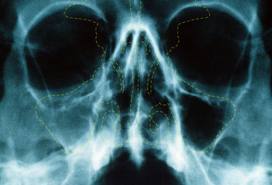
Plain x-ray showing opacification of right maxillary sinus Patients who undergo radiotherapy for nasopharyngeal carcinoma tend to suffer from sinusitis because irradiation causes damage to sinonasal tissue. There is very little information about the organisms causing sinusitis after radiation therapy. Two recent studies from China provided important information about the unique microbiology of sinusitis in these patients. Huang et al ( Am J Rhinol.   2007 ) endoscopically obtained specimens from 25 patients with acute sinusitis that developed sinusitis after irradiation therapy. Staphylococcus aureus comprised 42% and Gram-negative bacilli 36%  of all aerobic isolates. The main anaer obic isolates were Peptostreptococcus and Veillonella spp . Polymicrobial infections and beta-lactamase-producing pathogens were highly prevalent. A study by Deng and Tang ( Eur. Arch.Otolaryngolog, 2009) compared the bacteriology of chronic maxillary sinusitis that developed after radiat...

Are Topical Antibiotic Effective in Treating Chronic Sinusitis?

Image
Many different treatment options for chronic sinusitis (CS) exist but questions remain regarding the best options. While oral and intravenous antimicrobial therapies have traditionally been prescribed to manage CS, topical administration of these agents has gained increasing popularity over the past few years. Topical antimicrobials have the advantage of local delivery to the sinonasal mucosa and minimize the systemic effects seen with systemic agents. This is especially important in treatment of biofilms where higher concentrations of antibiotics are usually required. Topical antibiotic delivery devices to date have included nasal sprays, irrigations, and nebulizers. Nasal spraying of topical antibiotics are not believed to be very effective. This is supported by studies that have shown that the majority of deposition occurs only in the anterior part of the nasal cavity. In addition, the nasal sprays rely on mucociliary clearance to transport the drug from the anterior to the post...